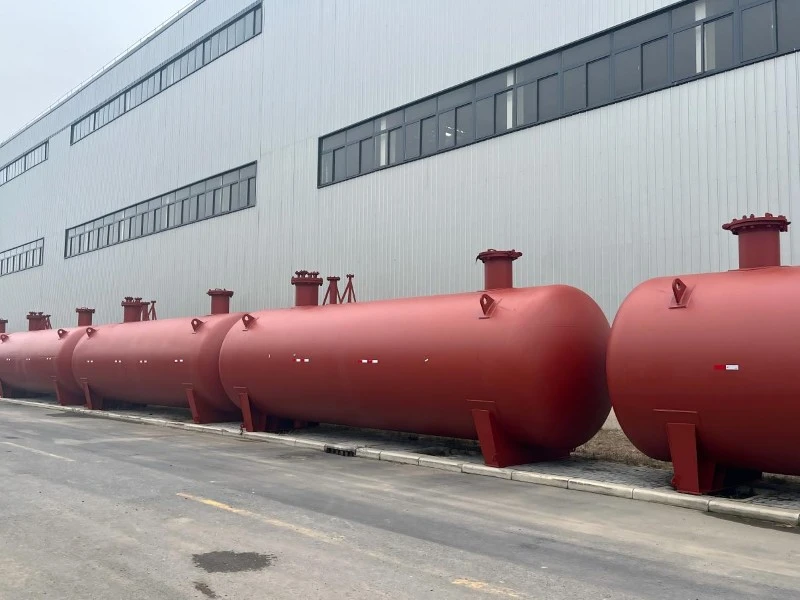
What are the characteristics of lpg tank?
1. Structural and material characteristics
High-strength materials: LPG tanks are usually made of high-strength steel, which can withstand the influence of internal pressure and external environment, ensuring safety and stability.
Double-layer or vacuum insulation design: Some LPG tanks adopt double-layer structure or vacuum insulation technology to reduce heat transfer and maintain the stability of liquefied gas in the tank, which is suitable for low-temperature storage needs.
Compact design: The tank body is compact in design, easy to install and transport, and suitable for a variety of application scenarios such as home, commercial and industrial.
2. Safety performance
Multiple safety devices: equipped with safety valves, pressure gauges, thermometers, leak detection devices, etc., to monitor the pressure and temperature in the tank in real time to prevent overpressure or leakage.
Seismic design: Meet seismic standards to ensure structural integrity and avoid structural damage in natural disasters such as earthquakes.
Explosion-proof design: The tank body materials and structures have been strictly tested and have explosion-proof performance to reduce the risk of accidents.
3. Operation and maintenance
Easy to operate: The design takes user-friendliness into consideration, and it is easy to install and use, suitable for non-professionals to operate.
Regular inspection: Safety inspection and maintenance are required regularly to ensure long-term stable operation of the equipment.
Remote monitoring: Some LPG tanks are equipped with remote monitoring systems, which can upload data in real time, facilitating centralized management and emergency response.
4. Environmental adaptability
Corrosion resistance: The surface of the tank body is treated with anti-corrosion to improve corrosion resistance and extend service life.
Adaptability to various environments: The design takes into account different climates and geographical conditions to ensure stable operation in various environments.
5. Capacity and type
Multiple capacity options: LPG tanks have a wide range of capacities, from small household tanks (5-50 kg) to large industrial tanks (thousands to tens of thousands of tons), to meet different needs.
Diverse types: Including household tanks, commercial tanks and industrial tanks, the design is optimized for different application scenarios.
6. Economy and convenience
Economy: LPG can be liquefied at room temperature, with low transportation and storage costs, and is more economical than other fuels.
Convenience: LPG tanks are small in size and light in weight, easy to carry and install, and suitable for use in homes and small commercial places.
7. Regulations and standards
Compliance with regulations: The design and manufacture of LPG tanks must comply with relevant national standards and specifications to ensure product quality and safety performance.
Special equipment certification: As special equipment, LPG tanks must be inspected by the Technical Supervision Bureau and issued a pressure vessel inspection certificate.